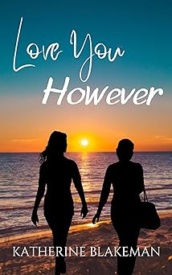


Get ready to learn more about the book Love You However in this discussion with sapphic author Katherine Blakeman.
Join us for an exclusive peek behind the scenes as we quiz Katherine Blakeman about Love You However, writing, reading, and more.
This book is part of the Growing Older category in the 2025 IHS Reading Challenge.
Why did you write Love You However?
I had long since had the idea of writing a character discovering they were non-binary. It had been tickling my brain for a long time, and after I released The Summer We’ve Had, I initially had another book on the go. But that one wasn’t quite doing it for me, so I abandoned it in favour of a sequel (of sorts) to The Summer We’ve Had. I’d had a vague idea of writing some sort of story for Jean and Petra, side characters in the first book, and suddenly one day the two things clicked. Jean could come out as non-binary, and the book could follow their story.
As for making Jean who they were, exactly… well, let’s start with age. Jean is 52. I wanted to reinforce the fact that being non-binary, or having gender dysphoria, is not just a ‘young person’s fad’ – that it can be the case in anybody, of any age. Similarly, I wanted to make Jean very much a ‘blend-into-the-background’, ‘person-next-door’ sort of character, to demonstrate that EVERYONE has stuff going on deep inside. Even the most innocuous of people, like your friendly local shop worker. So in short: you’re never too old to discover new, even life-altering things about yourself.
Who is your favorite character in the book?
My favourite character is not actually Jean, even though the story is told exclusively from their point-of-view. It’s Petra. Because only half of the book is about Jean’s gender identity – the other half is about the deterioration of their marriage with Petra.
Petra has a very open, charismatic ‘public face’ – but she can’t keep that up all the time. In time, she ends up unintentionally taking out the resulting stress on innocent bystanders, such as Jean, when she finds herself back in a safe space. All of this is set off, in the book, by her boss having a car accident, thus thrusting Petra into the role of acting headteacher at their school. In a way, I think she is actually more complex than Jean, because she is also carrying around a secret for most of the book. I enjoyed writing her for this reason, and because to be honest, I’d always liked to write a character that readers could swoon over. Jean likens Petra to a ‘Greek goddess’, with ‘a voice like melted chocolate’ and charm that wins over even the most ornery person. She was a lot of fun to write for this reason, almost as much as to be a partner for Jean!
What was the biggest challenge writing this book?
Honestly, not being an accidentally insensitive buffoon! It’s worth noting that I am not non-binary, I’m cisgender. And while I have a few non-binary friends, I’ve never really asked them about the details of being non-binary. So I embarked on a mammoth research task, concluding with a team of three non-binary sensitivity readers combing the manuscript for mistakes or inaccuracies. I’m happy to report that they found very few, and the ones they did find, I immediately corrected.
What part of Love You However was the most fun to write?
I wrote ‘the showdown’ – where Jean and Petra finally talk frankly about the breakdown of their marriage – in one evening. I was stuck in a cheap hotel about 60 miles from where I live because of train strikes, but I had my laptop with me. I wasn’t at that stage in the book yet, but I had so many lines straining at their leashes that would fit perfectly in this scene, so I finally allowed myself to write them out and string them together. The result is one of the most raw, emotional few chapters in the book – hell, in ANY of my books, in fact. And I loved every second of writing them.
How did you come up with the title for your book?
I distinctly remember where I was! I was halfway home from work, at a roundabout that joins the two longest roads of my commute together. I can’t really tell you what went through my mind, but I had a vision of Petra telling Jean: “I love you however you come”. Then, the string of words ‘love you however’ stuck in my mind. Its working title was ‘The Exception To Everything’, but ‘Love You However’ worked far better. (Fun fact: I then re-used ‘The Exception To Everything’ as the working title for A Different Kind Of Pride. Except then I renamed it again. One day, that title will get its own book!)
Where do you usually write, and what do you need in your writing space to help you stay focused?
I normally write in my conservatory. It has a sofa upon which I can stretch out, a fluffy throw since I’m normally pretty cold, and doors that I can shut, because I can’t write if I can hear voices. Then I normally put on my headphones (best £10 I ever spent), stick on some quiet jazz, piano or occasionally baroque music, and wring the words out of my brain via my hands. Some days are more successful than others – my writing style is a bit like a ketchup bottle: you either get everything or nothing. My friend gifted me a red scarf for Christmas, and I did briefly try having that next to me while I write, because I read somewhere that Enid Blyton kept a red shawl next to her writing chair because the colour red helped to stimulate her brain. But it didn’t work.
How do you celebrate when you finish your book?
Honestly, I don’t celebrate really. Is that sad? I just crack on with editing. Once it’s with my beta team, I allow myself to move on to the next project, which by that point is normally clamouring loudly for attention in my head. Hey, that’s my reward! Relief from the clamouring of the next WIP!
There is also chocolate. But I eat far too much of that, so we’ll skim over it. (That said, if anyone wants to send me a bar of Galaxy Caramel as motivation to finish my current WIP, I’m not going to stop you…)
What has helped or hindered you most when writing a book?
I tend to get over-eager, sometimes, and pack too much in. For example, the first (very early) versions of The Summer We’ve Had were set on a remote island. Cass was a burnt-out celebrity singer on the run from her rabid fans, relocating to a remote island off the coast of Croatia. Felicia (named Maria at this point) still had Dissociative Identity Disorder, but she also had a mute pre-teen daughter. Mabel was Cass’s landlady, and she had lost her own daughter as a child. So I was trying to pack DID, mutism, burnout and grief all in one book. Thankfully, a fellow author read a synopsis and told me, very plainly, to calm the hell down!
Have you ever cried when writing an emotional scene?
Yes, but not in any of my Sapphic books, weirdly. I cried at the epilogue of The Silent Chapter, my first book. It’s a historical (heterosexual) love story with elements of saga, and it grew up with me: I started it at 13, just before having major spinal surgery, and finished it at 16, just before I started The Summer We’ve Had. I broke my own heart with the final twist at the end, and combine that with my love for the characters, the length of time I’d been working on it, and the (not to toot my own horn too much) beautiful prose I created… it still gets me teary, even right now as I write about it. It’s why I can’t bear to take it off Amazon, despite the fact that a) nobody reads it any more and b) it has some major grammatical errors because I didn’t know any better at that time.
Do you feel bad putting your characters through the wringer?
At risk of sounding like some kind of Sapphic sadist, I LOVE putting my characters through the wringer! I do it to all of them; none of them are safe from me! Mostly because putting them through the wringer is how I get my story. A lot of them have already been through the wringer (like Petra and her escape from her family’s malign clutches, or Jean and their sister’s traumatic passing), and it is this that gives me the launch pad to, well… wring them again. BUT – and here is the key – I give them a happy ending. Always. They always come through it, however hopeless it may seem at one time.
What type of books do you enjoy reading the most?
As middle-to-late teen, my focus was mostly on historical fiction, post-1900s. I was studying it at college, and it intrigued me (still does) to see the fabric of today’s society being shaped. I read a lot of wartime books – which is probably why I wrote one, in The Silent Chapter. (I actually have a wartime Sapphic romance tucked away on my computer somewhere, three-quarters finished… one day you guys might even see it!) And then, when I was eighteen, I discovered Sapphic fiction. Yes, that’s right: I wrote Sapphic fiction before I even knew it was a thing. The first two Sapphic books I ever read were The Lives We Left Behind by Olivia Bratherton Wilson (a historical Sapphic romance, natch) and One Golden Summer by Clare Lydon and TB Markinson. That was it: I was converted. I still read historical fiction now and again, but once I crossed over into Sapphic fiction waters, I never looked back.
Are there any books or authors that inspired you to become a writer?
I know I’ve already mentioned her once, and I know she’s not exactly flavour of the month these days due to her casual racism, xenophobia and sexism, but Enid Blyton. The bits of her writing that AREN’T racist, xenophobic or sexist, are exactly what appealed to me as a child. I re-read my old Malory Towers books over Christmas, and just the simplicity and the nostalgia made me want to write. No wonder I used to write short stories as a child, when it was too wet to go and play outside!
What books have you read more than once in your life?
Well, I’m currently re-reading the entire Four Point series (including the initial trilogy) by Max Ellendale. I’ve read the majority of them individually, but out of order, so the side characters they share didn’t always make a lot of sense. Now I’m re-reading them all chronologically, and loving them more and more each time!
I am a big re-reader, actually. Other books I’ve re-read include The Art of Growing by Jacqueline Ramsden, All My Mothers by Joanna Glen, most of my childhood books such as Goodnight Mr Tom by Michelle Magorian and Opal Plumstead by Jacqueline Wilson, and Losing Touch by Jenn Matthews. But honestly, if I like a book enough that it sticks with me, I will often revisit it in time. Several times, even.