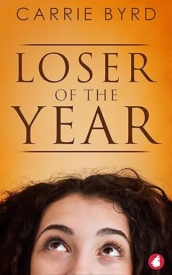

Get ready to learn more about the book Loser of the Year in this discussion with sapphic author Carrie Byrd.
Join us for an exclusive peek behind the scenes as we quiz Carrie Byrd about Loser of the Year, writing, reading, and more.
This book is part of the Self-Discovery category in the 2025 IHS Reading Challenge.
Why did you write Loser of the Year?
I’ve been a writer for years, but I’d never attempted a novel before I started working on Loser of the Year. It was the beginning of summer, and I needed something to occupy my brain for a couple of months that wasn’t academic work. My wife told me, “You should write a sapphic romance.” Like it was easy! She was so completely sure I could do it that I immediately believed I could too.
Because this was my debut, I wanted to stick with familiar subjects and experiences. Loser of the Year is a romance first and foremost, but it’s also a book about falling in love with teaching, and so much of my own teaching philosophy appears in it. Although the book is for adult readers and not YA, the general premise is very loosely based on my time as a Jewish lesbian theater kid at an all girls Catholic high school. Like Mattie, my Jewish lesbian MC, I felt very alien in a space that wasn’t built to accommodate all of me, and that in some ways felt actively hostile to my existence.
As a longtime enemies-to-lovers lover, I was also really excited about the challenge of writing a romance between two incredibly different characters who are actively hostile toward each other! For me, the fun of this trope isn’t just the sparks, it’s the work you’ve got to do to convince readers that these two people are actually made for each other.
Who is your favorite character in the book?
Jillian Reed, the arrogant girls’ soccer coach at St. Rita’s and Mattie’s love interest. For the first half of the book, Jillian is truly unlikeable. She’s egotistical, harsh, aggressive, self-serving, and given to black-and-white thinking. But I’ve loved her from the second she showed up in my brain, demanding to be heard. The key, for me, is knowing that beneath Jillian’s abrasive exterior lies a traumatized, emotionally terrified woman who loves very deeply and struggles to express it.
In most respects, I’m not like Jillian at all. I thrive in gray areas, and I’m a pretty warm and nurturing person (my temperment is much more like Mattie’s). But Jillian and I are both confident about our skills, even if I tend to express my confidence in more quiet ways than she does! I also identify with Jillian’s emotional walls; her journey there is partly informed by the work I’ve done on myself over the years.
Honorable mention goes to Emily, the irrepressible and sunny ninth-grader who isn’t always able to contain her immense excitement. I was a lot like Emily at fourteen, and writing her was a love letter to that younger version of me.
What part of Loser of the Year was the most fun to write?
Since Mattie’s a theater director, I needed a musical for her to put on with her students. Thanks to copyright, I knew I couldn’t use any lyrics from real musicals, so I created my own! Miss Munitions is an intentionally corny 1950s musical about a mostly female World War II munitions factory. I had an absolute blast coming up with the plot, characters, song titles (my favorite is “The Safest Plant in Northwest Wisconsin”), and lyrics. It’s a point of pride for me that my editor, Jae, actually looked up the lyrics to make sure they were available to use before realizing that I’d made up the musical!
How did you come up with the title for your book?
It was a suggestion from my wife, Roslyn Sinclair, who is brilliant at titles. It fit aspects of both character’s journeys perfectly, and I loved the boldness of using “loser” for a romance novel—something you don’t see every day.
If you’re planning a sequel, can you share a tiny bit about your plans for it?
A short story sequel is forthcoming from Ylva this fall, in their newest After Happily Ever After collection! It’s called “The Apostate’s Creed,” and it’s from Jillian’s perspective, about the first time she goes home to Gladbeck to visit her mother—with Mattie by her side—after coming out. Because Loser of the Year is entirely from Mattie’s POV, we don’t get to see directly how Jillian grapples with her sexuality and religious trauma, and I knew I wanted her to be the one to tell that part of her story.
I’ve also published a prequel short story called “The Passion of Jillian Reed,” which is set during Jillian’s college years, and is also from her POV. I can’t say too much about what happens, since that’ll spoil a major plot point in Loser, but I will say that it includes what’s probably the spiciest scene I’ve written so far. Subscribers to my newsletter get this story for free!
What is your favorite line from your book?
“What you’re running from isn’t worse than how it feels to hold it back.”
I also have a soft spot for a line that was inspired by Yiddish curses: “May she have hemorrhoids that weep more often than an unhappy toddler.”
What is your writing process like?
I’m a proud pantser through and through. I wrote Loser of the Year with no outline and only a few notes; I had some idea of what was going to happen (the big twist was part of the book idea from the beginning) but other parts came to me as I wrote, including Jillian’s moment onstage. Each chapter more or less told me what the next chapter needed to be.
I love how different this process is from basically every other aspect of my life, which is very organized and regimented! Writing is the one area where I let myself run on instinct.
Having said that, I’m currently working on a detailed outline for my third book. This one’s extremely plot-heavy and has a lot of moving parts, so I know I need a really clear sense of where I’m going with it before I dive in properly. I’m a little nervous about writing this way, but we’ll see how it goes!
How do you celebrate when you finish your book?
When Loser of the Year was published, we threw a book launch party! I gave a reading while wearing a large sash with “Author of the Year” on it (my wife’s doing), and we served a cake with the book cover on it. One slice ended up with just Mattie’s eyes. It was incredibly unsettling.
What animal or object best represents you as an author or your writing style?
I’m a banana slug! I move extremely slowly—every word has to feel right before I can move onto the next one. Whenever I stop writing, I always leave a few words to remind me where I’m going, just like banana slugs lubricate the ground in front of them.
What are three words that describe your personality?
Energetic, enthusiastic, and impulsive. I was diagnosed last year with ADHD, hyperactive-type, which explains why I’ve always struggled to sit still, why I interrupt people (I’m working on it!), and why I chatter on and on. I find it easy to be interested in most people and subjects, and so I tend to approach most parts of life with a lot of enthusiasm, which is something I appreciate about myself! I’m also a pretty cheerful person, and that’s typically the first thing people notice when they meet me.
What has helped or hindered you most when writing a book?
I’ve realized there’s no such thing as writer’s block—not really. If I’m stuck, what that means is that I’m trying to force the story to go somewhere it doesn’t want to go. And once I realize that’s what’s going on, then I have to figure out where the story wants to go instead, which I typically do through conversation. I’m an external processor, so epiphanies almost never happen when it’s just me and my laptop.
What hinders me most is when I’m lacking perspective. After I’ve finished a full draft, I’m unable to tell anymore whether or not that sex scene works, or if the characters come across the way I want them to, or if those lines I thought were funny actually are. It feels a little like being underwater and trying to see the entire ocean. What helps—other than beta readers and the editing process, of course—is letting the manuscript sit for a few weeks and then coming back to it. Sometimes I also change the font, and that makes it feel like a completely different book.
What author in your genre do you most admire, and why?
If you know me at all, you know that my wife is my favorite writer, and has been since long before she and I first interacted. But since I talk all the time about how much I love her work, I’ll take this space to mention a few other sapphic romance writers who inspire me to be better (this list is by no means exhaustive!):
Haley Cass is astonishingly good at creating visceral, intense feelings in her readers. Clare Ashton somehow manages to write prose that’s both simple and gorgeously evocative. Virginia Black is very, very skilled at creating delicious tension. J.J. Arias writes incredibly hot sex scenes that always feel deeply rooted in the characters involved. Ally North pulls you into another time and place so thoroughly you’re dizzy when you come up for air, and she never bogs you down in unnecessary detail. And E.J. Noyes is brilliant at character voice. I’m typically not a fan of first person POV, but the way she writes it gets me totally on board.
I’ve learned so much from all of these folks. They make writing romance look easy when it’s anything but.
Have you ever hated one of your characters?
I hate Cynthia Richter, the saccharine, prissy, and hypocritical principal at St. Rita’s. Loser of the Year has a number of morally gray characters, but there’s nothing gray about Cynthia. She’s just irredeemably horrible. There’s a moment late in the book where she tries to convince Jillian that the immensity of her shame is because Jillian knows on some level that acting on her queerness is wrong, and that was incredibly hard for me to write. Homophobia is awful enough, but the poisonous manipulation of using someone’s pain to hurt them more—all in the name of religion—is beyond cruel.
What books did you grow up reading?
As a child, I read anything and everything I could get my eyes on. The newspaper. A shampoo bottle label. Road signs. Laundry labels. And any book within grabbing distance. By age nine or ten, I was reading books written for adults (in retrospect, getting obsessed with Stephen King at that age probably wasn’t the best move), because I was so fascinated by grown-ups. My mother’s romance novels were especially educational, although I always wondered why the women in them were so obsessed with the men. Go figure.
Reading so much and so constantly really helped me learn what makes a story work. I figured out early on that the best writers find the universal in the specific and vice versa. In other words, they craft characters and experiences that are unique to a book’s particular combination of elements, but at their intersection, you’ll always find some exploration of what it means to be human.
Do you only read books in one genre or do you genre hop?
I read very widely, but the genres I return to most often are literary fiction, romance, historical fiction, non-fiction, drama, and poetry. I believe strongly that to be a good writer, you need to be a good reader, and that means consuming as many different kinds of writing as possible. But poetry is the genre closest to my heart. It’s taught me that each word is important, that rhythm is a crucial part of writing anything, and that reading (and writing!) is always best when you step in feeling-first, rather than head-first.