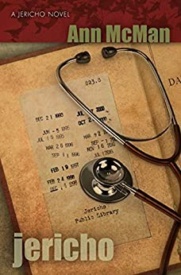


Get ready to learn more about the book Jericho in this discussion with sapphic author Ann McMan.
Join us for an exclusive peek behind the scenes as we quiz Ann McMan about Jericho, writing, reading, and more.
This book is part of the Virginia / West Virginia category in the 2026 IHS Reading Challenge.
Why did you write Jericho?
Jericho was written in 2010. In those days, a lot of lesbian/sapphic books and stories were fan fiction and posted on sites like The Athenaeum and The Academy of Bards. I was a big fan of these stories and read them voraciously. I had always wanted to write a book, and reading these stories led me to give it a try. So I wrote in the early mornings before work and on weekends. I wanted to tell a story that was funny and heartwarming, about a close community of real people. I had NO idea what I was doing—but soon ended up with a 500 page manuscript and no idea what to do with it.
Who is your favorite character in the book?
This is a toughie! Jericho is part of a four book series, and my favorites tend to shift with each installment. In all of the books, I tend to give one character my voice. In Jericho, I think it’s David. If you know me at all, it won’t be hard to see why . . . he shares my sense of humor.
What inspired the idea for Jericho?
I live in the South, although I’m actually from Pennsylvania. My parents had a small farm in the mountains of Southwest Virginia, and I became captivated by life in their small town on the New River. So I wanted the town of Jericho to replicate that—the simplicity, the quirky local characters, the beautiful scenery, the food, the challenges . . . all of it.
What was the biggest challenge writing this book?
Finding time to write it—and figuring out HOW to write it. I realized that the best way to write a book—hopefully, a good one—was to study how other good books were written. So that’s what I tried to imitate. I was also terrified about sharing it with the public once it was written. I was scared to death it wouldn’t be any good and I’d be mortified.
What part of Jericho was the most fun to write?
All of the scenes between Maddie and David because they mirrored, exactly, my relationship with my gay best friend, Trent. I recall one Sunday morning when Trent called me and said, without preamble: “Have you ever had any surgeries involving transvaginal mesh? Because you could make a LOT of money in this class action lawsuit . . .” I told him I didn’t know why I wasted my time trying to make anything up—I just needed to transcribe everything that came out of his mouth. So, I more or less did . . . And, yes—that scene is the book!
How did you come up with the title for your book?
I wanted a symbolic name for my idyllic mountain town—one that was a good metaphor for change and overcoming fear and obstacles. What better than Jericho? Not only is it a reference to the Biblical town (“By faith, the walls of Jericho fell down”)—but it was also the name of my favorite Joni Mitchell song.
How much research did you need to do for Jericho?
Tons. This has become a hallmark of my work. If I mention anything in a story—a place, a restaurant, a type of wine, a piece of art or music, a medical procedure—you can bet it’s real.
If you’re planning a sequel, can you share a tiny bit about your plans for it?
Jericho has three sequels: Aftermath, Goldenrod, and Covenant—all from Bywater Books. And there is a fifth installment in the offing—probably making its debut in 2027.
What is your favorite line from your book?
“Maybe, just once in a while, the universe did need a hand.”
What is your writing process like?
I am a dyed-in-the-wool outliner. I have to be. My books generally have multiple subplots and large casts of characters with several POVs. So I have to plan and outline to manage it all coherently.
Where do you usually write, and what do you need in your writing space to help you stay focused?
Because I am part-owner of Bywater Books and because I still work independently as a graphic designer, I have to go away to write. I take two months a year (nonconsecutive) to go off on self-styled writing retreats in Vermont. I stay in isolation and work twelve hours a day, seven days a week. Being an outliner and plotter is the only way this method can be effective. At the end of a month, I come home with a book.
If you could spend a day with another popular author, whom would you choose?
Dorothy Allison. Full. Stop. I was blessed to know her and become her friend and correspondent. But I never had enough time with her. A lifetime wouldn’t have been enough time. But she taught me more about writing during our brief interactions than I could’ve gleaned in a hundred lifetimes.
What’s your favorite writing snack or drink?
I tend not to eat or drink (at least, not anything noteworthy) while I’m working. But afterward? If it has cheese on it—it needs to hide.
How do you celebrate when you finish your book?
First, I sleep. Then a bottle of good champagne (I save the corks)!
Is there a particular genre you would love to write but only under a pseudonym?
Memoir. I am a survivor of childhood sexual abuse. One day, I would like to write about that experience and what the recovery process (still ongoing) has been like. It’s complicated because my abuser was a family member who is still alive. It’s also complicated because I am not certain how much readers in our community would welcome or respond to such a hard-hitting narrative. Perversely, instead of a pseudonym—which I write under now—I would use my own name.
Do you have any odd writing quirks?
I do! I have an absolutely ancient nub of a pencil that I’ve had forever. And I tend to fiddle with it while I’m working. It’s more covered with teeth marks than paint. Don’t judge . . .
Do you have a pet who helps/hinders your typing?
Ever lived with a Siberian husky? If you have, I’ll likely meet you in the support group . . .
What animal or object best represents you as an author or your writing style?
A deer. Nervous, furtive—but resourceful. Always looking for the next threat, but daring to poke my head out anyway.
What are three words that describe your personality?
Cautious. Irreverent. Empathetic.
What is the most valuable piece of advice you’ve been given about writing, and by whom?
“Be naked on the page.” This was from Dorothy Allison. Her way of saying tell the truth. Be honest and unafraid. It has changed everything for me. I am driven, always, to infuse my stories with real life content and the search for deeper connection and meaning.
What has helped or hindered you most when writing a book?
Self-doubt both hinders and helps me. I feel it constantly—hence, I work hard to overcome it.
When you’re writing an emotional or difficult scene, how do you set the mood?
It’s inelegant—but I have to just put my butt in the chair and do it. Writing about it is not much different than living through it. You put one foot in front of the other—and the only way out is through.
What do you do to get inside your character’s heads?
I hear their voices in my head. I am like the world’s greatest eavesdropper. I listen to them talk with each other—and I hear them as they work through their own situations.
If you could be mentored by a famous author (living or not), who would it be?
I’m a broken record here. It’s Dorothy Allison. Again, and always.
What author in your genre do you most admire, and why?
I think Lisa Alther. Her novels were game-changers for me. Also Julia Alvarez, simply for the beauty of how she uses language and her command of magic realism.
Have you ever cried when writing an emotional scene?
Oh, hell yes. Often it’s when I give one of my own experiences to a character and watch how they manage it. Dorothy in Goldenrod is a perfect example. I cried a lot writing her.
Do you feel bad putting your characters through the wringer?
I hope I never ruin a character’s life. It does make me happy when I can help them find better outcomes than many of us had when wrestling with the same issues.
Have you ever hated one of your characters?
I did. The evil mayor in Goldenrod. The true villain(s) in my mystery, Galileo.
Have you ever fallen in love with one of your characters?
Fallen in love? Maybe once. I wrote an upstart ten-year-old named Harrie—who was a sassy, eyepatch-wearing sidekick to main protagonist, EJ on her journey of self-discovery and mystery-solving in “Dead Letters from Paradise.”
What type of books do you enjoy reading the most?
Oh, I’m an old Luddite. I love Jane Austen and Charles Dickens. They are still my go-to authors whenever I have time to read—which isn’t often these days.
Are there any books or authors that inspired you to become a writer?
ALL OF THEM.
What books did you grow up reading?
Harry the Dirty Dog books by Gene Zion! Trixie Belden mysteries. Charles Dickens. Even Louis L’Amour! We had a old set of hardback classics someone had given my mother, and those were my most treasured reads growing up.
What books have you read more than once in your life?
I read “Pride and Prejudice” every year. Every year. Without fail. I practically have it memorized.
What book do you wish you had written?
There are too many to list here. If I had to pick only one, it would probably be “The Stranger” by Albert Camus. I love it’s sparsity. There isn’t a single word in it that doesn’t need to be there. Carmen Maria Machado writes the same way. As does Lorrie Moore. And Sheri Reynolds.
Describe your favorite reading spot.
An Adirondack chair on the banks of Vermont’s Lake Champlain.
Do you only read books in one genre or do you genre hop?
I read everything. I think I have commitment issues . . .
Have you ever thought you’d hate a book, but ended up loving it?
Cold Mountain. I was determined to hate it because I thought it would be a totally male-centric, Hemingwayesque narrative . . . too macho. I took a chance on it because I’d bought it in a bookstore promo where a bunch of titles were wrapped up in brown paper and you randomly selected one. Against my will, I ended up loving the story. It was extremely well crafted.