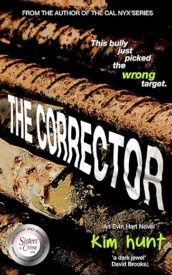
Get ready to learn more about the book The Corrector in this discussion with sapphic author Kim Hunt.
Join us for an exclusive peek behind the scenes as we quiz Kim Hunt about The Corrector, writing, reading, and more.
This book is part of the New Zealand category in the 2026 IHS Reading Challenge.
Why did you write The Corrector?
This story began as a response to a real life traumatic event I went through. I wanted to write a crime thriller from the POV of the crime victim. I was stalked by someone over a number of years and had to live in hiding. Obviously, I have fictionalised what happened to me and broadened the narrative but writing this novel was a way of getting beyond the immediate trauma and feeling empowered to go forwards with my life.
Who is your favorite character in the book?
Probably Gemma because she is so fearless and bolshie. She has a different psychology to Evin and approaches problems head-on without many constraints. Evin is brave in her own right and does amazing things despite some awful things that have happened to her. She is always working hard to overcome her circumstances and the psychological and emotional obstacles thrown up before her. I think the two characters provide a great foil to each other. Both are similar and different to me at various stages of my own history. Gemma is full of self-belief and optimism whereas Evin is more cautious, something she overcomes when pushed by a sense of outrage and anger.
What part of The Corrector was the most fun to write?
Probably the scenes towards the ending where Evin is on a mission on her custom built motorcycle. I’ve worked on classic bikes and cars so I have a passion for them. I love writing women who are competent and bad-ass and out there doing brave, dangerous stuff. I also loved writing Gemma following Mose Hickson at night because, again, it’s a woman being unafraid and doing what needs to be done. Women doing scary, action oriented things appeal because the world needs to see more of that.
If you’re planning a sequel, can you share a tiny bit about your plans for it?
When I finished The Corrector I realised I wasn’t done with those characters and the ending certainly suggested there was a possibility of more to come. The new story follows directly from the last action in The Corrector with a second plot threaded in alongside. Gemma and Evin feature with several new faces and one particular antagonist from the previous novel. I’ve just finished the first draft of the follow-up and it’s presently getting a structural edit before I get stuck into the rewrites. Exciting times.
What is your writing process like?
My process is a bit of a mash-up of both. I need to have some idea of the story arc before I begin, as in, I need to know a few major plot points and where I’m heading. Within that I have a lot of room to move and add sub-plots and allow for things to change direction. The tough part of this is that massaging these changes back into the story requires balancing many spinning plates in the air, especially if the plot is complicated. But I mostly don’t have the patience to plot everything out before I begin. Having said that, with The Beautiful Dead and The Quarry I did have much of the plotting clear at the beginning, relatively speaking, and this allowed me to just get on with writing the scenes.
Where do you usually write, and what do you need in your writing space to help you stay focused?
I drive to the coast in my old campervan and let my dog out to stretch her legs. I write in the back of the van. The quiet and solitude of the coast and estuaries are so welcome and I feel grateful to have such places within easy reach. Seabirds and water and waves. I can’t be there all the time but it’s my go-to. The rest of my writing is done sitting on the couch or at a desk or on my bed and grabbing what time I can to add to the word count. I’ve learnt not to be too precious about my writing space, that I have to just make do and get done what I can when I can.
How do you celebrate when you finish your book?
It’s weird but the process never quite feels finished, or, by the time I’ve got one book out there and published the next one has been in train for some time already so the writing is sort of continuous. I do like to go away on a road trip when I’m planning a new project, to see a new area, explore a different highway or back roads. Just a general freshening of my perspective. I always look forward to this roadie.
Do you have a pet who helps/hinders your typing?
Gabby is my 11 yr old rescue Staffy/mastiff cross. She’s my constant companion whether I’m writing at home or on the coast in the camper. It feels weird when she’s not with me which is rare. She pesters me to throw sticks or taps on her wristwatch to say “It’s feeding time, c’mon.” I’m not sure if her behaviours are a help or hindrance. I can’t bear to think of her as a hindrance so I’m gonna say that her antics are a support to my practice.
What is the most valuable piece of advice you’ve been given about writing, and by whom?
I can’t remember where I first heard it but I’ve seen it referenced many times. Any version of; “Read widely and write regularly.” The more I read the better my sense of what works for me and what doesn’t. The more I read the greater my bank of knowledge about the field I work in. It helps me to place my work. I read both both fiction and non-fiction.
The more I write, the better I get. It’s like a muscle that I exercise. The more I do it, the more limber I am.
What author in your genre do you most admire, and why?
Probably Michael Connelly for his Bosch series of crime novels. Connelly was a crime reporter for many years and his storytelling is so unadorned and clean. He tells brilliant mystery/thrillers without undue embellishment or indulging in graphic violence. For mine, he is an ultimate storyteller and his characters Bosch and Renee Ballard are compelling and utterly engaging. I always find his stories in this series believable and engrossing. Not all writers can pull this off.
What type of books do you enjoy reading the most?
I read a lot of mystery and crime fiction because this is my writing genre and I need to have a thorough understanding of my field. It’s also what I read for pleasure because there is such broad scope for exploring the human condition through stories with high stakes. I like the challenge of trying to work out the puzzle of a mystery. I also read literary fiction because these stories are also mysterious but are not structured in the way of genre fiction.
Are there any books or authors that inspired you to become a writer?
Helen Zahavi’s “Dirty Weekend” had a profound affect on me because it was such a shocking book and gave permission for writing a victim who takes action. I’d never read anything like it and as someone who had been the victim of numerous violences in my life as a girl/woman/queer it really spoke to me. At the time I was studying my undergrad degree and I’m sure it influenced my move towards writing fiction. The style and voice of the novel were also unlike anything I had read before and hugely inspiring. Canny and unique. As a working-class writer I rarely read books with that voice.
What books have you read more than once in your life?
Joyce Carol Oates’ “Blonde” and “Blackwater”
Annie Proulx “Postcards”
Michael Ondaatje “In the Skin of a Lion”
Toni Morrison “Beloved.”
Zora Neale Hurston “Their Eyes Were Watching God”
Helen Zahavi “Dirty Weekend”
There are probably others that I’ve read more than once but these are the first that come to mind. I keep coming back to these writers because of their lyricism. They are all wordsmiths with the ability to write a sentence or phrase that stops me in my tracks, where I have to just close the book and sit for a moment. Alongside the exceptional prose and imagination these stories all feature memorable characters and humanity. None of the books are in the crime fiction genre I write in bar perhaps “Dirty Weekend” which I stumbled on by accident and probably had much to do with the direction my writing took as it tells the story of a victim who fights back.