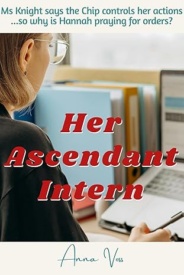


Her Ascendant Intern
by Anna Voss
Released: Feb 26, 2026
Genre: Erotica / Erotic Romance
Why this book and why now?
‘Her Ascendant Intern’ pretty much invented itself, when I was reflecting on some of my other work: while I cut my earliest teeth writing fanfic on A03 and Fanfiction.net, one of my first books as Anna Voss was ‘Mantamer’ – a dystopian F/m novella, cyberpunk-style domination through a neural implant, showing all my usual fascination with power and control alongside a kind of romance.
However, with a few more titles published, I was determined to get back to writing F/f. While ‘Mantamer’ does what it sets out to do, I’d invented a near-future setting where ‘behavioural modification’ technology was becoming mainstream – and I realised there was far more I could explore within that world. So Her Ascendant Intern explores those ideas in a way that adds much more emotional depth, and with a more deliberate pace: structurally, ‘Mantamer’ is driven by momentum and escalation; Intern lingers over interiority and motivation. And to be honest, what made it the right time was simply that once I started, it began flowing wonderfully: it’s always a good sign when a book feels like it wants to be written!
What is a significant way your book has changed since either the first draft or the way you thought it would turn out when you first had the inspiration?
Once I started writing, the whole dynamic of this book changed quite dramatically from what I thought it would be when I first planned it – I might still have the original post-its somewhere (I was in a very dull meeting when inspiration bit!). If you’ve read the book already, this will hopefully be a surprise, but my initial plan was for Hannah to end up with Ms Knight, the CEO; I meant for her secretary Beverley and the research lead Dr Campbell to be involved far more as “training” characters, helping teach Hannah how to submit in the ways Ms Knight might like – I think I even had a half-idea that Beverley might become a rival!
But then, the moment I started to write Hannah and Beverley’s meeting – or at least the moment they meet in Ms Knight’s office – it was obvious that their chemistry was too strong to ignore! The more I wrote of them, the more they quietly overruled my original notes, and shifted the whole book to something much more tightly focused on the pair of them. It meant Ms Knight had to change significantly and become a little older and more aloof, but actually that serves the structure of the narrative very well; it helps cement the sense of the company as very hierarchical, which gives a wonderful framing to the explicit power dynamics the book explores.
Would you and your main character(s) get along?
Oh, almost certainly! I can absolutely imagine Beverley and I getting completely sidetracked over a bottle of wine, dissolving into conspiratorial laughter while Hannah sits there blushing furiously as we dissect what we think she’s thinking. Beverley’s far more perceptive than Hannah’s point of view necessarily lets on: she’d be excellent company, and I think as long as she felt she could trust me, I’d love to delve deeper into her mind.
Do your character names have special significance or meaning?
A couple of them do – often I just pick names that feel like they’re correct! But in the earliest drafts Hannah was called ‘Cathy’. It didn’t quite feel like it fitted her, and so I changed it, quite deliberately, to Hannah: the beauty of that name for her is that it’s palindromic, unchanged whichever end you start from. So much of the novel is centred on the spiralling loops of Hannah’s own thoughts, and the way she’s learning to look at herself that a palindrome felt like a beautiful little nod to the overall narrative structure.
The other name I’d flag – even though it’s deliberately absurd – belongs to a book-within-a-book. In an early scene, Hannah attempts to distract herself from thinking about Beverley by reading the sort of Billionaire Romance her friends insist she should adore. (Spoilers: it does not help.) I had tremendous fun parodying the genre just enough to make it feel just plausible and yet faintly ridiculous, which is why the gruff, ostentatious billionaire rejoices in the name of “Cormorant Steele” – the rhythm suits the genre, but the moment you think about it, it suddenly feels daft. Given how little that book-in-a-book actually does for Hannah, I take an impish delight in calling him “Cormorant”: in the UK most of our cormorants are the kind called ‘the common shag’, which was almost painfully appropriate…
How does it feel to finally share this book with readers?
Honestly – it’s a little terrifying! I feel this way with nearly every book, but ‘Intern’ in particular makes me nervous; I’ve spent so long inside Hannah’s head, tracing her thoughts and experiences and hopes that I’ve grown extremely attached to her and Beverley. Hitting “publish” felt a little bit like thrusting them out onto a stage and not knowing whether the audience were going to throw things, but I hope they do well out there.
I don’t mean I desperately want them to do well commercially – I want them to work well emotionally, for them to feel real. So it’s a little terrifying because I fear people won’t understand them, the intensity of Beverley’s approach, or the strange, intimate methods of the Knight Initiative – wild though they may be! I’d never say that the Initiative is right for everyone, but I hope I’ve written everything sufficiently well that it’s clear this is what’s right for Hannah and Beverley, as individuals, moving in the world they inhabit. If I’ve conveyed even a fraction of the ache and hope Hannah experiences, I’ll be content.
Is there anything you wish readers knew before diving into this book?
I don’t know if it’s a wish, exactly, but I do hope readers approach it expecting intensity rather than comfort. This isn’t a soft workplace romance (although there is romance in it); it’s first and foremost a story about power, control, and discovery. It’s a romance grounded in finding that strange freedom that can exist within surrender.
I tend to write with one foot permanently on the “intensify” pedal, and ‘Intern’ is no exception, so the journey is unapologetically rooted in a femdom framework rather than in more traditional romantic arcs. I’m sure my ‘extra spicy’ approach to a number of scenes won’t suit every taste, but for those readers who enjoy a slightly darker bite to their reading, I think the emotional payoff will land with real weight.
What TV show would your main character(s) most likely binge watch and why?
I didn’t quite dare name it in the text, but at one point Hannah indulges in a little self-care by watching one of her favourite comedies because she takes comfort from the familiar mix of the ensemble and absurdity. That’s absolutely canonically her bundling up with a blanket and binging Brooklyn Nine-Nine – I’m usually terrible at keeping up with television, but B99 is my absolute go-to for comfort viewing, especially when I’m feeling ill or overwhelmed. Hannah spends so much of her life striving and overthinking that it felt incredibly natural she’d also reach for something comforting, and fast-paced, and fundamentally kind when she needs to try to centre herself a little.
Beverley is trickier: if you asked her she’d confess to being an absolute fiend for Bridgerton – how could she resist the combination of period costume, ceremony and power structures? – but she’s got such a soft streak in her, I think she has a guilty pleasure too. I’m morally certain she’d never admit it, but she also binges The Great British Bake-Off by the series: she also has strong opinions on the trajectory since Mel and Sue left, and still takes vehement sides in Bingate. (She’s Team Diana. All the fridges were terrible, and Beverley wouldn’t demand Iain’s Baked Alaska be perfect – but she’d expect him to submit something, not opt out of judgment. Beverley has all the time in the world for someone working through imperfection, but she still expects people to try their hardest, not throw everything away.)
What 3 things would your main character want with them if they got stranded away from civilization, and why?
Hannah’s not very outdoorsy, I’m afraid, and I suspect she never quite shakes off her desire for approval. She’d want a small pocket survival guide, one of the ones that helpfully covers everything from emergency first aid to making a shelter to navigating across a jungle ravine. She’d then read it obsessively so she knew what to do – and then she’d remain in place and await rescue!
She’d also want a wind-up radio, so she could track any search efforts – and honestly, I think she’d take the collar Beverley gives her. It has no practical function whatsoever – but being stranded away from civilisation is going to be horribly unsettling for her, and Hannah really needs structure to thrive. She’d trust that Beverley would keep looking until she was found… but if she’s stranded somewhere remote, she’d want that small symbol with her, so she’d know she wasn’t alone.
Which character was the most fun to write, and which was the hardest?
Hannah was the hardest to write because I had to write her with some precision: yes, ‘Her Ascendant Intern’ is a work of kinky erotica, but it’s also quite specifically character-driven: it’s the kind of novel that some readers will finish, and then want to immediately re-read to spot things that they may have missed on a first read.
Because so much of the book is filtered through Hannah’s own perspective, I had to be careful that everything had the right impact and effect on that first read, but was also clear and fair on a second. It was a challenge to render Hannah faithfully while maintaining that balance – but it was a satisfying one. I often enjoy setting myself little structural puzzles, and this book gave me plenty.
On the other hand, Beverley was absolutely the most fun – even seen mostly through Hannah’s eyes, she’s a fantastic character: sharp, confident, annoyingly good at things like drawing, which I can’t ever do well, and I tried to give myself every chance to deepen her that I could.
If your book were to be adapted into a movie or TV show, who would be your dream cast?
Oh, Ruth Wilson as Ms Knight, without a moment’s hesitation. Ms Knight ended up without enormous page-time, but she radiates that cool, effortless, faintly unnerving control – and I’m entirely confident Wilson could deliver that with only the smallest shift of expression.
I’m always hesitant to box readers’ imaginations in too firmly when it comes to main characters, but I might cautiously suggest Bel Powley for Hannah: so much of the book depends on capturing the particular blend of hopeful vulnerability and slightly panicked ambition that defines Hannah, so it would require careful casting, but I think Powley has a wonderful ability to make need and intelligence coexist on screen.
At the other end of the scale, Beverley would demand real nuance. Someone like Gugu Mbatha-Raw would be extraordinary: from what I’ve seen of her performances, she can really convey authority and depth without belabouring it too much, and that’s absolutely a Beverley thing.
…Mind you, though given some of the other elements of the novel, probably all of their agents would advise them against it!
If you could spend a day with one character from the book, who would it be and why?
I’m tempted to say Hannah: she might be the primary point of view and the driver of the whole novel, but I think she still has questions for me. We spent a long time together inside her own spiralling thoughts, and I have the benefit of knowing the answers to a lot of things long before she does – she certainly has the kind of mind that would interrogate me about that!
And, more than that – I know what Beverley and everyone else is thinking, even when we’re locking in Hannah’s point of view. As she’s written, Hannah is a character with “asking questions” virtually painted on her forehead – she’d definitely want to know what I knew! And besides… I care about her. I really do. I owe her a long conversation.
Publishing a book is a huge accomplishment and it’s time to party! Choose a celebratory beverage for one of your main characters to toast the release of your new book.
Beverley would insist on something deceptively simple but classic – probably a Negroni. Balanced, not too fussy; slightly bitter, but in a way that rewards patience.
Ms Knight either drinks single malt, neat – or possibly just mineral water. I suspect it’s the malt, though. Something light but deceptively peaty, perhaps an island malt. But I think Dr Campbell would ask for one of those sharing margaritas for four, without the slightest hint of shame: she deserves some consolation for the way I cut back her part!
If your book had a scent, what would it smell like?
If ‘Intern’ had a scent, it would begin with polished wood and crisp paper and the soft woolly overtones of expensive carpet: all the usual scents of a mildly sterile corporate office. I think it’s only when you’ve sat with it a while that you’d catch the undertones of warmth and heat and a fragrance that gets more beneath your skin with every breath. That’s the Velvet Helix way: clean lines on the surface, and the pulse of control thrumming away beneath.
Do you outline your books in detail, or do you prefer to discover the story as you write?
I generally start with an idea and then play with it in my head until I can see a broad narrative arc. Often, I do this while I should be doing other things, especially if it’s an idea that excites me! That said, once I know the general outline I’d like to get from A to B, I leave the fine details of how we get there to the writing process; I find it’s amazing what will happen if I follow the logic of what my characters will do next, rather than trying to plan too much.
It’s not pure laziness, though: as I hinted above, sometimes the characters flatly refuse to go anywhere near B, and instead the destination I’m writing towards turns out to be C instead. Secretly, I love it when that happens – it means the story’s alive, and I think it ends up feeling more real, because the outcome is the one which the characters’ own natures led them to.
Do you have any writing rituals or habits?
Whenever I get excited about a new idea, I try to get the first page or so written out on a manual typewriter.
Some time ago I challenged myself to write some F/m stories in the style of great authors of the past – to try and get a feel for the rhythm and flow of 1940s Noir – I impulse-bought a typewriter in a secondhand shop. And, at least for me, a manual typewriter makes for a brilliant proof of concept. It’s tactile and mechanical in a way my laptop never is, and the extra effort required instantly magnifies the creative pulse of the plot.
If the idea has real potential, then feeding in a second or third page and cranking the carriage back on each line is just part of the flow: the story’s momentum keeps you going. On the other hand, if the idea isn’t strong enough, there’s nothing to cushion you from the fact: you can feel the friction setting in very early, and that highlights if there’s something wrong with the concept.
If you could have dinner with any author, living or dead, who would it be?
I’d love to dine with Charles Dickens, although he’d probably be horribly scandalised by my work (and possibly furious with my pastiche of his Christmas Carol). I’ve always been fascinated by his work – he draws wonderfully vivid characters, and often with more humour than you might expect. Even by the standards of his day, some of his views were appalling – yet he was a fiercely passionate campaigner for social reform and compassion for the poor, especially in the face of institutions designed to cause disadvantaged children harm. I’d love the chance to grill him on that tension.
Besides, they say when he’d do dramatic readings of his own works, people would be carried out sobbing at the passion of his performances. I don’t know that I’d survive the evening – I’m soppier than I look! – but as someone constantly fascinated by the power of words, I couldn’t possibly resist the chance to see that kind of intensity up close.