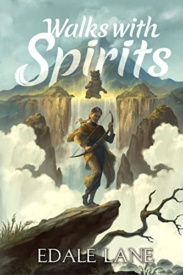


Get ready to learn more about the book Walks with Spirits in this discussion with sapphic author Edale Lane.
Join us for an exclusive peek behind the scenes as we quiz Edale Lane about Walks with Spirits, writing, reading, and more.
This book is part of the Canada category in the 2026 IHS Reading Challenge.
Why did you write Walks with Spirits?
When my partner and I decided it was time to move to Canada, I was moved to write a novel set in the British Columbia lower mainland, where we chose to move. I was working on other projects, but started jotting notes. Upon arrival in the gorgeous valley bowl of Chilliwack, surrounded by misty mountains, I found myself immersed in an ancient spiritual energy. I wanted to write the story of people who lived there, undisturbed, hundreds or thousands of years ago. The trickling rivers, deep lakes, and enduring mountains spoke to me, as I imagine they spoke to the Indigenous Peoples of the River. While drawing on actual history, this novel is a work of historical fantasy that blends fact, myth, and romance.
Who is your favorite character in the book?
Walks with Spirits, or Spirits, for short. Like me, she is in touch with nature, loves animals, and is a two-spirit woman who embraces a masculine role. No, I don’t identify as two-spirit because that designation is reserved for actual First Nations people. However, I have always felt split between my feminine and masculine energies, preferring traditionally “men’s” work, dress, and activities. Spirits is also a spiritual soul, seeking knowledge and wisdom from beyond and within herself. And she’s fearless. Spirits differs from me in that she’s learning and experiencing all this in her youth, while it didn’t come to me until I was much older.
What was the biggest challenge writing this book?
I faced two challenges writing this book, which actually took me longer to complete than any of my novels except Heart of Sherwood. First was the research. I consulted books and maps, visited museums, interviewed First Nations neighbors, climbed mountains, waded in the Chilliwack River, and listened to nature. Second was a more politically charged hurdle to get around. I originally wrote this as historical fiction, but because I’m not Indigenous, I was told I couldn’t do that. I wasn’t qualified to tell someone else’s story. Fair enough, but I’d already written a beautiful, compelling love story. So, the rewrites began. After the changes, I sent the manuscript to an official First Nations sensitivity reader. She pointed out a few more changes I should make, then approved it for publication. When I looked for an audiobook narrator, I chose a Native Alaskan who was proud to read the story.
What part of Walks with Spirits was the most fun to write?
It was all fun for me to write, full of wonder, truth, and possibilities. But the most fun PART of writing Walks with Spirits was bringing to life a society where LGBTQ+ persons were honored and respected. One village even courts one of my main characters to move there because they don’t have a two-spirit resident and need the good luck he would bring. I also enjoyed writing Whale with Teeth, a whaler from the coast, who struggled with his inability to connect with the spiritual world, and was stunted by jealousy. He brought an opposite perspective from Spirits’.
If you could spend a day with another popular author, whom would you choose?
I’ve answered this question in other interviews, and try to name a different one each time. Most are really famous authors, like Tolkien, Agatha Christie, and even J. K. Rowling. (Hey, she changed the world. Maybe I could learn something.) So this time, I’m curving right back around to sapphic authors. I’ve been reluctant to do that, lest I name one of my friends and not all the others. So, I ran a search for “most famous sapphic authors.” Google did not include Edale Lane. 😒 It did list quite a few of my peers with whom I correspond or say hello to on Facebook. 🙂 I think I’ll be safe from offending any of them by saying Sappho. That’s right, the ancient Greek poet, the one who started it all. Of course, I’d need a good translator, but I think it would be truly fascinating to pick her brain and soak up her vibes.
Do you have a pet who helps/hinders your typing?
Piper! My little Havanese is always “helping.” She lies on my feet, at the side of my keyboard, behind my neck, whatever odd place strikes her fancy—that is when she isn’t hopping up and down at the side of my chair saying, “Mommy, play with me!” “I need to go out – NOW!” “Look— a squirrel! Arf, arf, arf!”
What do you do to get inside your character’s heads?
I just pretend I’m them. Put myself in their situation, their mood, their intelligence level. What they like, don’t like, and how confident or not they are. Then, like a method actor, I try to think and feel as they would when framing their words and actions.
Have you ever hated one of your characters?
I have never “hated” a character I wrote. That’s a strong word, and I try to make even my villains well-rounded, with honest motivations for their bad behavior. But there are some I don’t like and wouldn’t want to hang out with. In this book, Thunder Warrior is that character. In a society that promotes equality and charity, he’s an irreverent, misogynistic … oh, I won’t spoil it for you. You can make up your own mind.
What books did you grow up reading?
I grew up reading the classics: Sir Arthur Conan Doyle, Edgar Allen Poe, Hemingway, Steinbeck, Tolkien, Robert Louis Stevenson, Melville, etc. With dyslexia, I was a slow reader and mostly read books assigned in my literature classes. But my mother loved Agatha Christie and read many of her mysteries aloud to me. I think they influenced my desire to include action, adventure, and mystery in almost everything I write.
Have you ever thought you’d hate a book, but ended up loving it?
I’ve answered this one before too, but in case you don’t remember … Gideon the Ninth. Necromancers in Space. What? I read slow, so I ALWAYS choose something I KNOW I’ll like. But my book club picked this, and it does feature lesbians, so I got the audiobook. The writing is so witty and creative and hilarious, and the plot so convoluted, spiked with surprises, that I couldn’t stop listening. I LOVE Gideon and rooted for her all the way. And it wasn’t that sci-fi—easy for a non-sci-fi reader to follow. The necromancy fantasy is the real vehicle, not the spacecraft. Now, I’ve finished the second book in the series, and #3 is in my Audible library awaiting its turn.