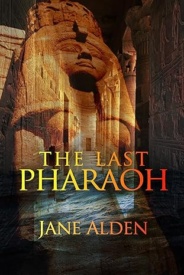

Get ready to learn more about the book The Last Pharaoh in this discussion with sapphic author Jane Alden.
Join us for an exclusive peek behind the scenes as we quiz Jane Alden about The Last Pharaoh, writing, reading, and more.
This book is part of the Egypt category in the 2026 IHS Reading Challenge.
Why did you write The Last Pharaoh?
The Last Pharaoh is the last book in a trilogy. Cass must come to grips with an ethical question. Should she expose a secret to the world that would bring her international and lasting fame or stay true to a promise made thousands of years ago?
Who is your favorite character in the book?
Dr. Cassandra Stillwell is a scientist. Very different from me. I’m always “up in the clouds”. She finally has to listen to her heart though.
What inspired the idea for The Last Pharaoh?
For centuries, people have sought the final resting place of the most famous Pharaoh, Cleopatra, without success. I’ve had a theory about where she may lie, and I wanted to play it out.
What was the biggest challenge writing this book?
Very practical ones: Covid and a huge decision to move. The Last Pharaoh took two years to write. My stories usually take six to eight months.
What part of The Last Pharaoh was the most fun to write?
The part where Ari goes home to North Carolina to help her grandmother save a friend from an unscrupulous nursing home. I was born and raised in a small town in Arkansas, so the situations and the people in Beaufort, North Carolina were familiar to me. Living in Los Angeles, I sometimes miss the slower, simpler life of a Southern small town.
How did you come up with the title for your book?
I struggle with titles. The Last Pharaoh is my seventh novel, and the easiest one to name so far. Cleopatra was in fact the last Pharaoh of Egypt. The Roman Emperor Octavian conquered her navy at Actium and annexed her country as a vassal state. By the time Cleopatra ruled, a female on the throne was not such an oddity as in Hatshepsut’s time. When I struggle to name a story I’ve learned to relax and let the title come out as I go along.
How much research did you need to do for The Last Pharaoh?
Tons. Donna and I took a riverboat cruise from Cairo to Aswan, so that helped a lot. AI was a big help, but one can’t depend on him (for some reason I picture Chat GPT a male.) to write the book for you. He’s good for research as the Internet is. He does a lot of the work by gathering information in one place.
If you’re planning a sequel, can you share a tiny bit about your plans for it?
The Last Pharaoh is the third and final book in a trilogy; The Crystal’s Curse about Hatshepsut, The Queen’s Eye, about Nefertiti, and the Last Pharaoh about Cleopatra. I’ve started my next book, and it’s about a different time and place.
What is your favorite line from your book?
Some secrets deserve to rest.
What is your writing process like?
I have a general idea at the beginning, but my characters take the reins and drive the story. Often it feels like I’m watching a movie and taking notes. My last five books have been mystery/ thrillers. I like leaving clues for readers that will turn out to be important, but that aren’t obvious at the time.
Where do you usually write, and what do you need in your writing space to help you stay focused?
I have a desk in front of a big window that looks out on our backyard. There’s a hummingbird feeder that provides just enough distraction.
If you could spend a day with another popular author, whom would you choose?
I’d love to have met Patricia Highsmith. In 1952, she wrote the first lesbian novel with a hopeful ending, The Price of Salt. I’d love to talk to her about her decision to write the story, how she found a publisher, her writing process, how it affected her life.
What’s your favorite writing snack or drink?
Coffee, no matter what time of day. I try not to snack.
How do you celebrate when you finish your book?
Tell everybody I can find that I’ve finished, and then start on the next one. The characters are usually anxious to get going.
What is the most valuable piece of advice you’ve been given about writing, and by whom?
I was doing a reading at Golden Crown from my first novel, Across a Crowded Room. I mentioned to the listening group that I found it hard to write sex scenes. Somebody in the audience said, “Just remember it’s not you.”
When you’re writing an emotional or difficult scene, how do you set the mood?
Describing the surroundings in detail and how they seem to the character through her five senses. My last three books have been written in first person. While this presents limitations (The character knows only what she can see and hear or what someone else tells her.) I think this adds to the emotional impact.
What do you do to get inside your character’s heads?
I think there are four kinds of people: idea geniuses, people geniuses, data geniuses, and plan geniuses. Of course none of us is that simple, but I use this lens to think about how a character would think and react.
Have you ever cried when writing an emotional scene?
In my first book, Across a Crowded Room, one of the main characters describes an experience she had that changed her life for good. The scene was based on a real-life experience I had, and I relived it while writing it.
What type of books do you enjoy reading the most?
Lately I’ve been going back and reading the books that our brave writers of the past wrote: The Price of Salt by Patricia Highsmith, A Curious Wine by Katherine Forrest, The Well of Loneliness by Radclyffe Hall. I’m interested to see if they show where we were as a society and whether we’ve moved on or not.
What books have you read more than once in your life?
The Price of Salt. I’ve got a copy that was second-hand to start and now is practically falling apart from being read so often. I love Carol and how brave she was. She chose living a life that was true to herself in spite of society’s barriers.