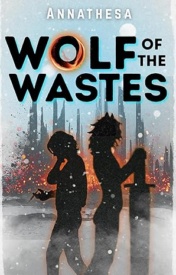
Get ready to learn more about the book Wolf of the Wastes in this discussion with sapphic author Annathesa Darksbane.
Join us for an exclusive peek behind the scenes as we quiz Annathesa Darksbane about Wolf of the Wastes, writing, reading, and more.
This book is part of the Fantasy category in the 2026 IHS Reading Challenge.
Why did you write Wolf of the Wastes?
I wrote this book for myself, out of spite, when I felt like I couldn’t write anything. But I also wrote it for a close friend, who felt the invisible, internal battles they fought were never seen. We were both really struggling at the time, and the main character’s hurdles are a blend of both our challenges. In writing it, I came to understand what made life so much harder for them, and hoped that this book might make others feel seen or understood, as well.
And why now? I didn’t have a choice. The story had to get out; it chose, not me.
Who is your favorite character in the book?
Whew. A hard one. The main character, Isangri, is most similar to me and I love her dearly. But my favorite is probably her best friend, Kija. She’s protective, unshakeable, loyal, and rock-solid reliable – but not someone who’ll go along with everything you say, either. Less reflective of me and more my ideal of a companion. Though on reflection, I’d like to think that’s how I am with my son, at least. A girl can certainly hope.
What part of Wolf of the Wastes was the most fun to write?
Oh, the beginning. It was a challenge to get it just right, and I love a challenge. There’s so much that goes into the start of a book that you have to balance, and it feels so good when it clicks. The very end is a super close second, though. And for similar reasons. The rush of a final conflict, tying everything together, plot twists, then one decisive moment with everything on the line…and then stillness. It ends, for you and the characters alike. It’s something I find hard to describe (other than how I did describe it, just now. lol).
How much research did you need to do for Wolf of the Wastes?
Oh. My. Gods. I ran into the same fantasy worldbuilding issues I always do, diving down rabbitholes about how shapeshifting would affect how a society develops, the realistic economics of a post-apocalypse, and even stuff about physics, disease transmission, or how many bullets an airlock door could stop. It gets crazy. Eventually I reach a point it’s less about the research and about what level of detail helps the story rather than hinders it. …This is a problem everyone has, right?
If you’re planning a sequel, can you share a tiny bit about your plans for it?
I can say I already have it outlined, to an extent. And the closer for the trilogy, plus loose arcs for a time skip followup series. When and how much of that happens really depends on what readers think of it, though. I’ve already changed my original ending idea for the sequel based on what people enjoyed from the first book, for example.
What is your favorite line from your book?
Hehe, the easiest question, hands down.
“And here I thought you were just a doctor,” she teased.
“Few people are ‘just’ one thing. I’ve had to wear a lot of hats in my time.”
It’s not about it being a super cool quote or anything; more that it’s a description of my publishing journey and life in general. But I also use it in real life, both when talking to others or to remind myself that we tend to view people through a pretty flat lens; by their job, their relation to us, their public image. But real people, the whole person, goes much deeper than that. Like an iceberg, there’s so much we never catch at a glance.
What is your writing process like? Are you more of a plotter or a pantser?
I’m fully half and half. I like to refer to myself as a “plantser.” Before you laugh (or groan), it’s actually pretty appropriate – I work best when I have a skeleton of the story and character arcs so I don’t miss anything, but one that’s not too restrictive so the story can breathe and grow on its own as I write. I need some structure and a bunch of idea seeds, but if there’s too much structure I get frustrated and feel restricted. And if there’s not enough structure, I flounder and miss things. I look at this as the best of both worlds, and struggle more if I lean too much to either side. In fact, that’s the only challenge with the method; straddling the line just right so the story flows.
If you could spend a day with another popular author, whom would you choose?
Define popular. Close to the top would be Brandon Sanderson; I’d love to chat about worldbuilding from the person I consider to be the current best at it. But I’d actually choose Jerry Holkins (Tycho from Penny Arcade fame). He doesn’t write much fiction, but the elegant, biting wit and descriptive expressions even in his blog updates have inspired my writing style more than any fiction writer ever will. I also think we could share some rambling, super interesting conversations across a ton of different topics.
Do you have any odd writing quirks?
I used to think that making the characters’ facial expressions as I wrote, especially during dialogue, was a weird quirk. But I’ve had a post about it go slightly viral, and seen a couple more since, and it turns out a lot of authors think it’s a weird quirk that surely no one else does. So if you, like me, sit in the dark making faces at the monitor for hours a day, know you’re not alone.
When you’re writing an emotional or difficult scene, how do you set the mood?
Depends on the reason I’m struggling. Sometimes the answer is re-reading key scenes that define a character to me, to really get into their head. Other times it’s reflection on personal events close to the emotional resonance I’m reaching for. A lot of times it’s just taking a few minutes to rock out to my carefully curated playlists for different series and characters, made precisely to help future me zero in on the right headspace. And if it’s something different, like feeling out a fight scene, I’ve saved a bunch of inspiring clips to rewatch for that purpose too. (My favorite is the Neo vs. Smith subway scene from the first Matrix movie; it’s the tone-setter for every fight in my Dying Ashes series.)
If you could be mentored by a famous author (living or not), who would it be?
Well, being mentored by any dead author would certainly be an amazing experience! More seriously, I’ll refer to my earlier answer about Jerry Holkins here too. In this case it’s less about the level of fame and more about my level of respect for the person and their craft. Getting that kind of feedback would let me know I’m on the right track and kill a lot of self-doubt for sure.
Have you ever cried when writing an emotional scene?
Oh, quite a few of them. In fact, that’s my standard for whether I write a scene well enough; if I’m not feeling the intended emotions, why would I expect a reader to? So I rewrite it until I do. I think the one that stands out to me the most is the ending of my novella series, though, with several characters saying their goodbyes after the adventure is over. They weren’t just saying their goodbyes to each other; they were saying them to me, and me to them. It was the first time I’d closed the book (heh) on a story completely, and it hit harder than I’d ever have expected it would.
What books have you read more than once in your life?
So, growing up I wasn’t allowed to watch TV, listen to music, or play video games until I was in my mid-late teens. So books were my big (and only) thing for a long time! We were also very poor, so new books came infrequently. The result was that I’d save up and buy a series, then rotate through them over and over. One week might be Moorcock’s Elric of Melniboné, the next might be Wheel of Time, David Eddings, Conan the Barbarian, or everything by R.A. Salvatore. Living in those worlds was an escape, but also a joy. Although I didn’t have a lot of alternatives but to return to the richness of those stories, I also look back on that time fondly.
Do you only read books in one genre or do you genre hop?
One genre cannot contain me. I grew up with a “fantasy is best!” mindset, until a friend’s solid sci-fi recommendation (Ender’s Game) cracked that perception, and The Dresden Files fully put the nail in its coffin. Now I don’t really care about what genre something is. It’s all about the characters, the prose style, the writing quality, and how the author handles the story’s potential. I’m very picky about those, though; there are a lot of books I pick up and don’t make it far into.
Have you ever thought you’d hate a book, but ended up loving it?
Hate is too strong a word, but I was pretty skeptical of Dungeon Crawler Carl (sacrilege, I know). Mostly because of how people described it, and my experience with some other books in the genre. But DCC isn’t like anything else in the genre. I was also concerned that Carl would end up being the generic “insert self here” male protagonist prevalent in a lot of media…but no way, not even close. In fact, I ended up relating to Carl so heavily it made the series one of my favorite (and fastest, sadly) reads ever.