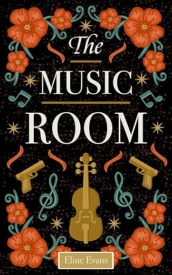


Get ready to learn more about the book The Music Room in this discussion with sapphic author Eline Evans.
Join us for an exclusive peek behind the scenes as we quiz Eline Evans about The Music Room, writing, reading, and more.
This book is part of the Sweden category in the 2026 IHS Reading Challenge.
Why did you write The Music Room?
Many years ago, my grandfather told me a story from his own childhood of growing up in Denmark during WWII. It’s a terrible story about the murder by German soldiers of a young couple. I imagined a version of that story where the couple had children who survived this awful crime and what that might have done to them. That became Elinor and her sister Helene’s origin story.
Who is your favorite character in the book?
Annemarie, the love interest. She’s definitely similar to me in some ways. She’s curious and meticulous, she works hard and I love how honorable and honest she is. I definitely wouldn’t have had her courage to do what she did to save Helene! She’s a very multidimensional character too, driven by the guilt of something she had no fault in. A sort of original sin. I found her fascinating.
What inspired the idea for The Music Room?
The Music Room is inspired by personal experience in a weird way. The book centers around a building quirk of the main Copenhagen building, Christiansborg Palace. The Prime Minister’s office is above the so-called Royal Representation Rooms. The Great Hall has a sort of balcony for musicians (called The Music Room) but to access it, you have to go through the Prime Minister’s office. Years ago, I worked at the Prime Minister’s Office and since I have a lively imagination, I always wondered if this wasn’t a bit of a safety breach? I imagined a plan where someone infiltrated the orchestra to carry out terrorism or an assassination of one of the very important people down in the Great Hall. That eventually turned into the story in The Music Room! I used to work with declassified information from the Cold War and so I already knew a lot about far left groups and so it seemed obvious to make Helene’s group that.
What was the biggest challenge writing this book?
The riddle that Helene gives Elinor so she can find her when she’s taken, and which Annemarie then solves! It took me days of doing different codes to put it together so it made sense.
What part of The Music Room was the most fun to write?
Helene! She’s got such great, wry humor. She’s very honest, too, about herself and about others. She recognizes her own pain but still struggles. She’s flawed. I loved writing her relationship with Elinor, especially. They have such a strong sister bond and they deal with their trauma in different but both unhealthy ways. I liked exploring their different reactions to being adopted, and the way Elinor’s talent for music acted as an escape that wasn’t available to Helene and how Helene really struggled as a consequence.
How did you come up with the title for your book?
It was obvious. It had to be The Music Room. It’s the focal point for the entire book. The plot wouldn’t exist without the Music Room.
What is your writing process like?
I’m a plantser. I always have a pretty good idea about the outline up until about the midpoint and I know the ending, but I don’t have the whole thing plotted chapter for chapter before I start. I need some mystery to keep me going.
Where do you usually write, and what do you need in your writing space to help you stay focused?
On my bed with my laptop on my lap. Honestly, I just need my computer! I have kids so I get interrupted a lot. It’s just how it is. I’m good at snapping back into focus after I’ve fetched yet another snack.
If you could spend a day with another popular author, whom would you choose?
Isabel Allende. I love her books and she’s lived such a fascinating life. She’s an expat like myself (we actually live in the same county!). She’s such an inspiration, donating vast amounts of money to women’s charities. I’ve always felt such a…a freedom in her books. You can tell she writes exactly the story she wants without worrying about the “rules.” I’m in awe of her storytelling.
What’s your favorite writing snack or drink?
Diet Pepsi. No recipe. That’s a Pepsi Co secret!
What animal or object best represents you as an author or your writing style?
Maybe an octopus? I’m a multitasker. I work on several writing projects at once. Drafting, re-reading, editing. I also design my own covers and do my own character art and I’ve started doing that for other authors too so I’m always going between projects as if I had eight arms.
What is the most valuable piece of advice you’ve been given about writing, and by whom?
A story is “the human heart in conflict with itself.” I heard it from George R. R. Martin but it’s originally a William Faulkner quote. It’s the one thing I keep in my head when writing, the inner turmoil of the character.
What do you do to get inside your character’s heads?
I need to know their background and their trauma. Who hurt them and what triggers that hurt. Elinor, for example, is emotionally unavailable because of her traumatic childhood. She can’t commit to a girlfriend and the only person she’s close to is her sister. It’s not until her relationship with Helene breaks apart that Elinor can open herself up to Annemarie and fall in love.
What author in your genre do you most admire, and why?
Kiran Millwood Hargrave. She’s an amazing writer of historical fiction and (I think) all her adult books are sapphic to some degree. Her prose is beautiful and her stories are very touching. The details of her historical settings are amazing.
Have you ever fallen in love with one of your characters?
Yes. Ana de Orellana from my upcoming book The Ruby Reaper. She’s a pirate captain with a hard exterior who’ll hurt anyone who tries to harm the people she cares about. She’s funny and brave and sexy, but the thing that really made me fall for her is the way she cares for her adopted daughter.
What type of books do you enjoy reading the most?
Historical fiction has always been my genre. I’m a nerd and I love history so it makes sense. I’m not, however, a big fan of the sort of historical fiction that follows the upper classes. I love stories about rebels and outcasts and people who forge their own destiny with nothing but determination. I also love a retelling! I’m a huge sucker for mythology and folklore and I love to see what an author makes of an “old tale.” I’ve read a lot of the newer Greek myth retellings but at this point I’m more looking to read from other mythologies and lores.
What books did you grow up reading?
My mom read The Little House on the Prairie for my sister and me. That was where my love for historical fiction started. There isn’t a lot of children’s historical fiction (especially not in Danish. I didn’t start reading in English until I was almost 30) so I started reading adult books pretty early.
What book do you wish you had written?
One of those 700 page ones you could get away with back in the day. Something like Anna Karenina or Gone with the Wind. Or a family saga stretching decades, like House of the Spirits, only sapphic. I’ve always loved The Hunchback of Notre Dame and I’m working on a sapphic retelling with witches. Maybe after I’ll do Les Mis. I love that one too!