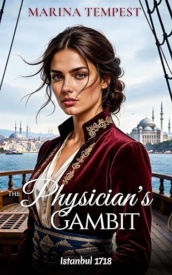


The Physician’s Gambit
by Marina Tempest
Released: Apr 29, 2026
Genre: Historical Fiction
Why this book and why now?
I have a degree in historical linguistics, which means I am incapable of entering any historical period without immediately asking… what language were they speaking, and what did that language let them think? Istanbul in Ottoman times is one of the most linguistically and culturally layered cities in human history — Ottoman Turkish, Arabic, Greek, Venetian Italian, Persian, all in conversation in markets and harbors and palaces simultaneously. I wanted to be there.
But the “why now” is really about medical knowledge as power. Who gets to know what, who profits from that knowledge, and who dies because they can’t access it — that’s not a 16th-century question. It’s (unfortunately) current events. Leyla’s gambit is specific to 1718, but the thing she’s fighting for is exactly what we keep fighting for. I didn’t plan to write a political book, but here we are.
Do your character names have special significance or meaning?
Leyla means “night” in Arabic and Turkish — which felt right for a woman who operates in shadows, who does her most important work before dawn, and who is often invisible to the powerful men around her. Deniz means “sea” in Turkish. She commands the Aegean. She’s named for what she can’t be without.
And then there’s the ship. Yıldız means “star.” A star is what you navigate by. It’s distant, fixed, and reliable. It guides people home.
Did any real-life events or personal experiences influence the story?
Variolation — the smallpox inoculation technique Leyla steals — is real. It was actually practiced in the Ottoman Empire in the early 1700s before it made it to Western Europe, brought to England partly by Lady Mary Wortley Montagu after she observed it in Istanbul.
What’s one fun fact about your book that most people wouldn’t know?
The hammam that opens the book isn’t just a bathhouse — it’s an intelligence network. Hammams in the Ottoman world were genuinely one of the few spaces where women could gather and exchange information without male oversight. They functioned as a kind of parallel news economy.
The fun fact is that the hammam in the epilogue — the one Leyla builds in Alexandria — is structurally based on a real Ottoman hammam that still exists today.
Which character do you relate to the most, and why?
Leyla. I don’t have her courage, but I recognize what she does where she builds a completely rational case for why something risky thing is necessary, talks herself into it, and then is genuinely surprised when the emotional consequences catch up with her later.
That’s a too familiar pattern. I also recognize her inability to walk away from a problem once she’s identified it — she sees that the knowledge exists, that children are dying who don’t need to die, and there really isn’t a question of whether or not to act. The cost is a different question, of course. I understand that way of moving through the world.
Which character was the most fun to write, and which was the hardest?
Yasemin, the first mate, was the most fun — because I knew exactly what she was doing from the moment she appeared on page one. She sees Leyla and understands what Deniz is doing by letting her aboard. Every scene Yasemin is in, she’s the most competent person present and she knows it. She’s choosing to let Deniz figure things out on her own timeline. I love her.
The hardest was Deniz in the middle section, when she has to be simultaneously furious at Leyla, unwillingly reliant on her, protective of her, and actively refusing to acknowledge any of it. She’s allowed to be difficult and guarded; she’s not allowed to be unkind. That’s a narrow path.
Publishing a book is a huge accomplishment and it’s time to party! Choose a celebratory beverage for one of your main characters to toast the release of your new book.
Leyla would pour raki, not the expensive kind that court officials drank at official functions — the rougher version she discovered when she was sixteen, and a healer in the spice quarter offered her some after a long day and said, “This is what real Istanbul tastes like.” She’s never forgotten that. Raki goes cloudy white when you add water, which she has always found genuinely beautiful — this transformation from clear to opaque, changing when you introduce something new to it.
If your book had a scent, what would it smell like?
This one smells like rose water, mineral stone, and sea air with an undercurrent of wood smoke.
The book opens in a hammam — the steam, the rose oil, the smell of centuries-old stone that has been heated and cooled and heated again. That scent carries through the whole story for me, even on the open water. Leyla carries it with her. And underneath that is the Aegean itself, clean wind, salt, and the dry heat of Mediterranean sun on wood. That combination is the feeling of the book — something ancient and warm running underneath something wild and dangerous.
Do you have any writing rituals or habits?
The garage is my year-round writing space — it’s warm enough in winter (usually), it’s separate enough from the rest of the house that I can mentally shift gears. There’s something about walking to a different physical space that shifts something in my brain.
For this book specifically, I had an enormous printed timeline on the wall behind me — the Ottoman court calendar, the Venetian trade routes, the linguistic geography of what languages would be spoken in which ports. Call me a nerd. 🙂
Who are your biggest literary influences?
Octavia Butler is a big one. What I keep returning to in her work is the way she refuses to comfort the reader — she shows the world as it is, power as it actually functions, survival as it actually costs, and she trusts the reader to handle it.