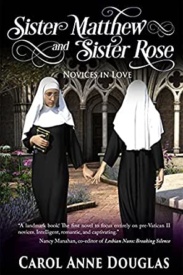


Get ready to learn more about the book Sister Matthew and Sister Rose in this discussion with sapphic author Carol Anne Douglas.
Join us for an exclusive peek behind the scenes as we quiz Carol Anne Douglas about Sister Matthew and Sister Rose, writing, reading, and more.
This book is part of the Maryland category in the 2026 IHS Reading Challenge.
Why did you write Sister Matthew and Sister Rose?
I grew up Catholic, went to a convent school and as a child I wanted to enter religious life. I never did, and I’m now an ex-Catholic. But I know several lesbians who went in the convent and are now ex-nuns, including Nancy Manahan, who edited the wonderful anthology Lesbian Nuns: Breaking Silence. I’ve always been intrigued by what it would be like to be in the convent.
Who is your favorite character in the book?
I suppose my favorite character is Maureen, who doubts everything about Catholicism but enters the covnent anyway. She is like me, and like me she formulates her own ideas about what Jesus and Mary were like. Maureen doesn’t fit in, but she tries to, especially after she falls in love with another young woman who has also entered.
What inspired the idea for Sister Matthew and Sister Rose?
Meeting several ex-nuns (using the popular but not correct term for sisters in the convent), especially Nancy Manahan, who edited the anthology Lesbian Nuns: Breaking Silence.
What part of Sister Matthew and Sister Rose was the most fun to write?
There’s a bit of a mystery. I enjoyed writing about Sister Doubting Thomas, a former high school principal who decides to solve the mystery.
How much research did you need to do for Sister Matthew and Sister Rose?
I remembered a great deal about Catholic schools and sisters, but I did research a little theology and what nuns and priests did when living under Hitler. I learned that more than one thousand priests were killed in Nazi death camps because they resisted. I hadn’t klnow that before.
What is your writing process like?
I’m a pantser. I know what will happen and what the ending will be but I don’t write an outline. I sometimes jump around in the story rather than always writing from start to finish. I like the process. I try to write somewhat from front to back so other members of my writing group will find it easy to understand.
If you could spend a day with another popular author, whom would you choose?
I suppose I would spend the day with Jane Austen, although her confined social circle would drive me crazy. I would enjoy seeing how she responded to annoying people in real life and watching the expression on her face.
What animal or object best represents you as an author or your writing style?
A beaver. I’m very diligent and just keep at it.
What are three words that describe your personality?
I’m gentle. I may think angry thoughts or create sarcastic comments, but I don’t say them. I’m intellectual. I love books almost beyond anything and read whenever I can. I’m political. I always keep up with politics, including international politics. I contribute to candidates and groups I believe in and I go to political protests.
When you’re writing an emotional or difficult scene, how do you set the mood?
I just jump into it. I don’t do anything particular.
What do you do to get inside your character’s heads?
Getting in characters’ head is automatic. They’re in my head. I don’t need a special process.
What author in your genre do you most admire, and why?
Barbara Kingsolver. I admire her books because they are well-written. She deals with individual and societal problems through describing her characters’ lives.
What type of books do you enjoy reading the most?
Serious fiction, generally that written by women, especially books set in other countries that interest, such as India, China, Nigeria and Eastern Europe, as well as books set in the Nazi era. I also read some nonfiction set in these places because I want to learn about them. But I also of course read books set in the US, including books by Black and Native American women, and books set in England and Ireland because I feel ties to them. I read more books set in widespread parts of the world not because my tastes have changed but because they are more accessible now.
What book do you wish you had written?
I have written a “sapphic retelling” of the Arthurian legends, Lancelot: Her Story. I have read many books about them, including Sir Thomas Malory’s Le Morte d’Arthur and many contemporary versions. I’m fascinated by every retelling. The books include so many human and political dramas, including of course the forbidden love between Lancelot and Guinevere.
Do you only read books in one genre or do you genre hop?
My favorite genre is serious contemporary fiction, but I also enjoy mysteries and an occasional fantasy. I want to both to learn about the world as it is and sometimes to escape from the world as it is.