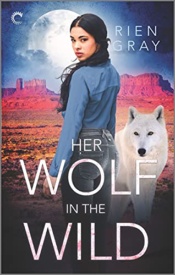

Get ready to learn more about the book Her Wolf in the Wild in this discussion with sapphic author Rien Gray.
Join us for an exclusive peek behind the scenes as we quiz Rien Gray about Her Wolf in the Wild, writing, reading, and more.
This book is part of the Paranormal category in the 2024 IHS Reading Challenge.
Why did you write Her Wolf in the Wild?
I’ve always loved werewolves, but in the media I grew up with, werewolves were almost exclusively cishet men (see: the Underworld movie series, Van Helsing, etc). They’re muscular, hairy, aggressive, dominant, so on and so forth. Then I read Blood and Chocolate, which was the first book I ran into where women were werewolves, too, and that made a huge impact, as did finding the game Werewolf: the Apocalypse soon after.
As a nonbinary person, shapeshifting has an obvious appeal, but I wanted another aspect to connect to the werewolf story when I wrote it to distinguish this book from others, and that came in the form of a motorcycle club. MCs function a lot like packs do in werewolf media, so once I got those two pieces in my head of using a biker group as a cover for a group of shifters, Her Wolf in the Wild was born.
This book is primarily a romance between a butch alpha werewolf and her fated human mate, and I imagine that is the majority of the appeal, but I also wanted to focus on the freedom that can come from queer found family, reconnecting to nature, and healing from abusive relationships. Also, ACAB.
Who is your favorite character in the book?
Micah Nubilo – the werewolf love interest – wins out as my favorite, because I always want more butches in every media, but it was also intriguing to write someone with so much power and the heavy mantle of her inheritance who was romantically and sexually very innocent. She and I share our a stoic demeanor, certainly, although I can’t say I’m otherwise anything like a 6’3 biker who lives in the middle of a desert.
How much research did you need to do for Her Wolf in the Wild?
For the Arizona setting, not very much because I lived there for four years and also spent a lot of time in the state growing up because my grandparents had a house out in the desert. In regards to the motorcycle club aspect, it’s always been a side interest of mine, especially since queer leather clubs are often left out of the stereotypical image of MCs, despite some of the oldest groups being almost 60 years old.
For that research, I read a few books, but I also visited The Leather Archives, which is a one-of-a-kind museum in Chicago about the LGBTQ+ community and leather, and they have a ton of memorabilia and recorded interviews with actual members of these clubs. It’s a really awesome place.
What is your favorite line from your book?
“I’m a werewolf,” I say, holding her gaze.
“Bullshit,” she mutters, but her shoulders sink. Acceptance in all but name. “Prove it.”
Out of the question. With the way my wolf reacted at the river, I’d kill her. “I just said I wasn’t going to hurt you. Transforming into a seven foot tall beast is not how to go about that.”
“You get even taller?”
The fear in Christiana’s voice is overwhelmed by heat rushing up to her face. She’s blushing, and putting two and two together makes me feel so brainless it’s dizzying. I never considered that she would want me too. Now there’s no chance.
“Yeah,” I admit with a weak smile. “I get taller.”
What is your writing process like?
I’m absolutely a plotter in the most straightforward sense. I do full outlines for every chapter and almost exclusively write in order unless I’m really struggling with a particular scene. But I also often get single lines of conversation or description in my head or sudden jolts of inspiration while working on a story, so I also keep a side document that’s just all of those bits in a row, which serve as fuel when I’m looking for new imagery or something interesting.
What I like best is that I basically never have to redo my drafts or chapters extensively. If there’s a plot hole or trouble with scenes connecting, I catch that in the early stages of outlining before I’ve put down thousands and thousands of words. The flip side of that is that I have to do the work first. I do wish I was a faster or on-the-fly drafter at times, because I have so many different book ideas that it feels like I’ll never have time to finish all of them. When I finish one story, ten more appear in my head.
Where do you usually write, and what do you need in your writing space to help you stay focused?
I can write anywhere, which can be equally parts enviable and distracting depending on whether or not I have other obligations – like my day job. Sometimes this is on my phone or a notebook, or whatever else is convenient, although if I have a large amount of words to get through, I try and settle in on either my desktop or laptop with a set music playlist and my headphones, coffee and a lot of water to get in the zone. I’m a very highly caffeinated individual, but it’s terrible to get a hydration headache a thousand words in – getting knocked out of that focus spot can knock me off kilter for the rest of the day.
Do you have any odd writing quirks?
I have to have my title first. Like before I outline anything at all, I need that anchor point. I usually have an idea of the protagonists and general story path but nothing gets grounded or solidified until the title comes to me, which means I can be stuck for a while sorting through turns of phrase before it lands. I have no idea why this is the case, but it’s been true as long as I can remember, so it’s just part of my ‘write a book’ checklist from the very beginning.
What is the most valuable piece of advice you’ve been given about writing, and by whom?
“I learned never to empty the well of my writing, but always to stop when there was still something there in the deep part of the well, and let it refill at night from the springs that fed it” is from Hemingway, and I came across it when I was a teenager who was struggling to write longer works of prose. I’d get hyper-focused on a project, even giving up sleep to get more words down, but that grind meant I would also suddenly stall out from exhaustion, and then could never pick up that project again. The spark was gone.
After running into that quote, I decided to stop my writing each day in the middle of a sentence. Which might seem odd, but because I knew how the rest of the sentence was supposed to end, I could immediately pick it back up the next day. Getting those few words in let my rhythm reset, and knowing that I had a plan to continue the next day (after a good’s night sleep) evened out my pacing without worrying I’d lose focus. Taking that stress off myself means that often my inspiration flows easily during rest periods, and I can come back to the page refreshed and ready to go.
I’ve written twelve books so far, so it’s worked out pretty well.
If you could be mentored by a famous author (living or not), who would it be?
I’d love to work with Nicola Griffith in any capacity. Her work across genres is tremendous, and there’s something so visceral about the voices of her protagonists, which is a trait I seek to embody in my own work. That the same person who wrote the lesbian noir classic The Blue Place could transition to arduously researched Dark Age British historical fiction is impossible not to be impressed by.
Are there any books or authors that inspired you to become a writer?
I read In the Forests of the Night by Amelia Atwater-Rhodes as an adolescent, which I enjoyed a lot, but when I got to the bio in the back and realized that Atwater-Rhodes was only 15 years old when the book was published, it lit this fire in me, like, “wait, can I do that, too?”
It was a very logical fire, though. I didn’t think I could get a book published by 15, but I told myself I could finish drafting a novel by 18 – which I did. It was an entirely different paranormal romance than Her Wolf in the Wild, and this was back far enough that I had to mail a printed copy of the manuscript to a publisher in the hopes of getting it picked up. Which it did not (kudos to teen me for trying), but I got a very nice personalized rejection letter from the publishing house, likely because I mentioned my age in the query.
I assumed at the time that I wasn’t one of the 1% cut out for trad and continued to write as a hobby throughout college, but it wasn’t until after graduation and a hard burnout from my day job that I decided I was going to write books again. I’m deeply grateful to how digital publishing has made this so accessible.
What books did you grow up reading?
I maxed out the holds on my library card every week as a kid growing up, so I can’t even begin to make a full list. Jacqueline Carey’s Kushiel series was certainly formative, though, as she taught me so-called purple prose was capable of creating lush, indulgent, queer worlds that enthralled for hundreds and hundreds of pages.
The sheer volume I read was important, I think. All kinds of genres, styles, and ages of books. I grew up in fairly substantial poverty and have no formal writing degree or training, but I did have the library and a voracious appetite for both new words and figuring out how a book “worked” – be that in terms of character, plot, or language. I probably wrote a million words of hobby stories before getting to the point I felt comfortable writing a novel, but now I can’t picture doing anything but writing books.